I recently rebuilt my personal site as a static blog hosted on AWS. Here’s the architecture and why I made these choices.
Why Static?
For a personal blog, static site generators hit the sweet spot:
- Cost: Pennies per month on S3/CloudFront
- Performance: CDN-cached HTML is as fast as it gets
- Security: No server to patch, no database to secure
- Simplicity: Markdown files in a Git repo
I chose Hugo for the generator—it’s fast, has great themes, and the learning curve is gentle.
The Architecture
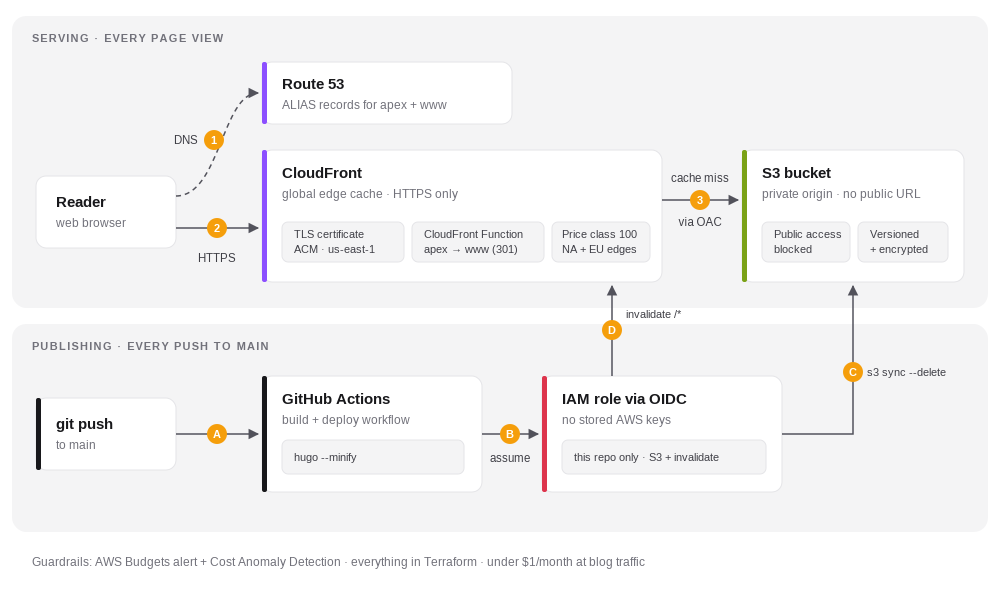
Here’s the whole thing: how a page gets to you, and how a new post gets published.
Components
Route 53 handles DNS, pointing the domain to CloudFront via an ALIAS record.
CloudFront serves as the CDN, caching content at 450+ edge locations worldwide. It handles HTTPS termination and protects the origin.
ACM provides free SSL certificates. Must be provisioned in us-east-1 for CloudFront compatibility.
S3 stores the static files. The bucket is private—CloudFront accesses it through Origin Access Control (OAC), not public URLs.
Cost Breakdown
For a low-traffic personal blog, expect roughly:
| Service | Monthly Cost |
|---|---|
| S3 | ~$0.03 |
| CloudFront | ~$0.10 |
| Route 53 | $0.50 |
| Total | < $1.00 |
This assumes modest traffic. Even at 100K page views/month, you’re likely under $5.
If you have questions or want to discuss the architecture, find me on LinkedIn.